A/B Experiments
Test one page inside a funnel — a quiz step, the paywall, an upsell — or two whole funnels against each other, with up to four variants running at once. Appfunnel reads every variant on the metrics that matter and tells you the moment one has genuinely won.
This is experimentation that tells you the truth: variants are authored where you build, each visitor keeps the one they were given, and every variant reports its conversion rate, its ARPU, and its revenue per paying customer, side by side with the control. One metric calls the result — ARPU, the revenue each variant earned per visitor it was shown to — so a lift you promote is a lift you banked. You promote the winner in one click, and the ledger keeps the receipts. It does what a human growth team can’t do alone: test more, forget nothing, and decide on money, not hunches.
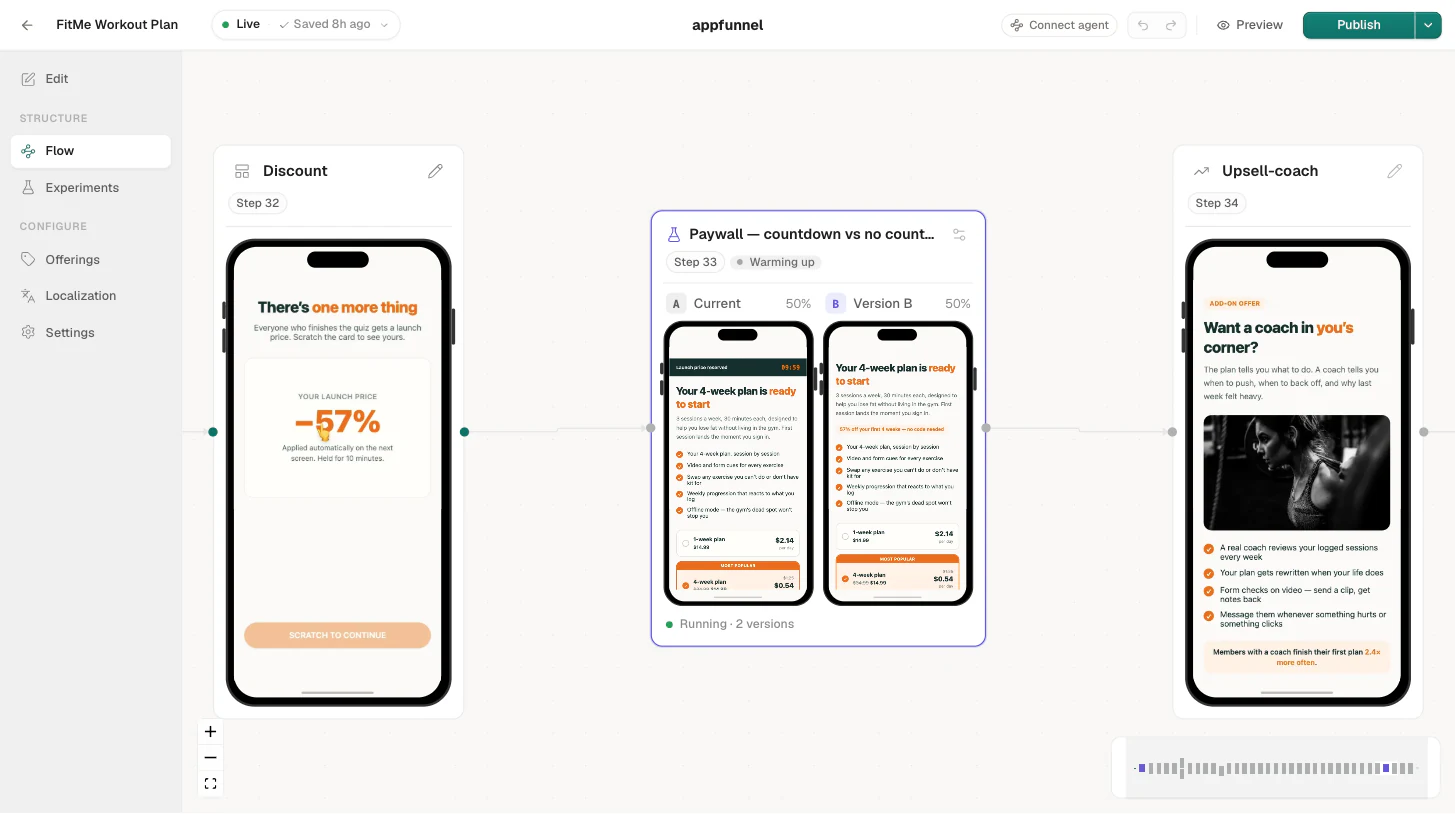
Test a page, a funnel, or four ideas at once
Most tests aren’t a rebuild of the funnel. They’re one page against another, three or four ways at a time, running everywhere at once — and Appfunnel is built to run them at a scale you couldn’t supervise manually.
Test one page, not the whole funnel. Fork any single page (a quiz step, the paywall, an upsell) into a second variant and test it in place, with the rest of the flow untouched. This is the test most teams run most of the time.
Or put two funnels head to head. Point a campaign at rival funnels and let live traffic choose between them. Same dashboard, same verdict, same one-click promote.
Up to four variants at once. A test isn’t stuck at A against B: run your control plus up to three challengers, at whatever weights you want, and read them side by side.
Read every metric per variant. Visitors, conversions, conversion rate, ARPU, and revenue per paying customer are broken out per variant, each with its confidence range, so you can see why one won and not just that it did.
Assignment sticks to the visitor. Each visitor is held to one consistent variant across visits, so a subscriber never sees the test flicker.
Authored in the builder. Start a test from the page node in the flow, right where you build the funnel. The web builder and experiments are one surface, not a bolt-on.
Know when you have a winner
An experiment shouldn’t need a meeting, or a guess, to call a result. Appfunnel runs the statistics for you and tells you the moment a variant has genuinely won, so you promote it on evidence in one click.
Pick what you’re testing
Click a page in the flow to fork it into a second variant, or set two whole funnels against each other from the campaign. Up to four variants per test. No separate harness to wire up.
Traffic splits, and it sticks
Each visitor is held to the same variant across visits, so every variant gets a clean read and nobody sees the test flicker.
Every metric is measured per variant
Visitors, conversions, conversion rate, ARPU, and revenue per paying customer, each reported per variant against the control: the numbers of record, not vanity clicks.
The stats get run for you
You read all of them, but only one calls the result: Appfunnel scores each variant against the control on ARPU — the revenue it earned per visitor it was shown to — so a variant only reads as won when it earned more, and only when the lift is real rather than a lucky streak.
You promote the winner in one click
When a variant clears the significance bar, Appfunnel flags it as a real winner. You confirm the promotion and it takes over the funnel, no redeploy. Promotion always takes a human confirm.
A ledger you can trust
Speed only helps if you can trust the verdict. Every variant reports its full set of numbers, one of them settles the result on realized revenue, and the whole thing is kept in a ledger you can audit.
We run the stats for you. Every experiment is scored the moment there’s enough data. A variant reads as a winner only when the lift is genuinely real, not a lucky streak, so you promote on proof rather than on the first day that looked good.
Read all the metrics. Each variant reports its visitors, conversions, conversion rate, ARPU, and revenue per paying customer side by side, every rate with its confidence range. Guardrails flag a variant that lifts revenue while quietly hurting checkout starts or refunds.
One metric calls it. The verdict is settled on ARPU — revenue per visitor shown, not per paying customer — so a variant that wins the click but loses the sale doesn’t get crowned. The other numbers tell you why it happened; this one decides.
A full history. The ledger keeps every experiment, variant, and outcome: what you tried, what won, and by how much.
Promote or hold, your call. The engine tells you when a variant has genuinely won; you promote it in one click, or hold it. The decision is always a human confirm, never an automatic swap.
Where teams use it
Rewrite one paywall, leave the rest alone
Fork the paywall into a second variant, keep the quiz and the upsell exactly as they are, and see which paywall earns more per visitor.
Try three headlines, not one
Put a control and three challengers on the same quiz step at once and find out which framing carries people furthest.
Test a quiz against a landing page
Pit a multi-step onboarding flow against a static page and let revenue pick the winner.
Find the offer that earns most
Run trial, no-trial, and price variants side by side and promote the one with the highest realized lift.
Keep improving after launch
Leave experiments running so the funnel compounds small wins instead of freezing at v1.
Let an agent propose the test
Have a coding agent draft a variant, ship it into the experiment, and read the result back.
Questions, answered directly
Can I test a single page, or does it have to be the whole funnel?
A single page, and that’s the usual case. Click any page in the flow — a quiz step, the paywall, an upsell — and Appfunnel forks it into a variant you edit like any other page; the rest of the funnel is untouched and keeps running as it is. Testing two whole funnels head to head is the other option, set up from the campaign that routes them, and both kinds land in the same dashboard and read the same way.
Am I limited to two variants?
No. A test runs your control plus up to three challengers, so four variants at once, labelled a through d. You set the traffic weights while the test is a draft and they rebalance as you add variants. Each one is scored against the control and reported in the same table.
Which metrics can I see per variant?
All of them: visitors, conversions, conversion rate, ARPU, and revenue per paying customer, each with its confidence range, plus the lift over the control. Guardrails watch the reached-checkout rate and the refund rate, and block a variant that wins on revenue by hurting either. And when the variants are whole funnels, each one is a funnel in its own right, so you can point the analytics dashboards — MRR, trial conversions, refunds, ad spend — at a single variant too.
How many experiments can I run at once?
As many as you have ideas for. There is no cap on the number of experiments, no traffic cap, and no plan gate — every experiment carries up to 4 variants (your control plus three challengers). Appfunnel scores each one for you, so the constraint becomes ideas rather than attention.
How do I know when a variant has actually won?
We run the stats for you. Appfunnel scores every variant against the control the moment there’s enough data and tells you the instant one has genuinely won: a real result, not a lucky streak or a first-day fluke. When a variant clears the bar, you promote it in one click; promotion always takes your confirm, never an automatic swap.
How are winners decided: clicks or revenue?
Revenue. You read every metric per variant, but exactly one of them calls the result: ARPU, the revenue each variant earned per visitor it was shown to. A variant that wins the click but loses the sale doesn’t get promoted, and neither does one that converts more people onto a cheaper plan. The other numbers explain the win; this one decides it.
Will a visitor see a test flicker between variants?
No. A visitor is assigned one variant and keeps it across visits, so a returning visitor always sees the same one and entering an email partway through can’t move them. The experiment is invisible to the subscriber and clean for you to measure.
Can my coding agents run experiments?
Yes. Because every funnel is a real React project, a coding agent can draft a variant, ship it into an experiment, and read the confidence-scored result back: the same ledger a human sees. Experiments and the builder are one surface, not a separate tool.
Related features
LTV Analytics & Attribution
The realized-revenue cohorts experiments are scored against.
AI Web Builder
Author variants right where you build the funnel: one surface.
Payments & Billing
The verified purchases that decide which variant actually won.
Subscription Management
Turn the winning offer into an entitlement your app gates on.
Developer platform
Have coding agents propose, ship, and read experiments over MCP.
Test at a scale a team can’t. Know exactly when you’ve won.
Test one page or a whole funnel, four variants at a time, read on every metric and decided on revenue: free for 14 days.