AI Web Builder
Appfunnel’s AI web builder turns a description of your funnel into a live, phone-previewed web-to-app flow you can publish the same day: quizzes, paywalls, and A/B variants included, with real React underneath when you outgrow plug-and-play.
It is plug-and-play first: no engineers, no build pipeline, and nothing locked away. The depth is underneath: the same funnel a non-technical founder ships in an afternoon is code a developer or a coding agent can extend when a page needs more.
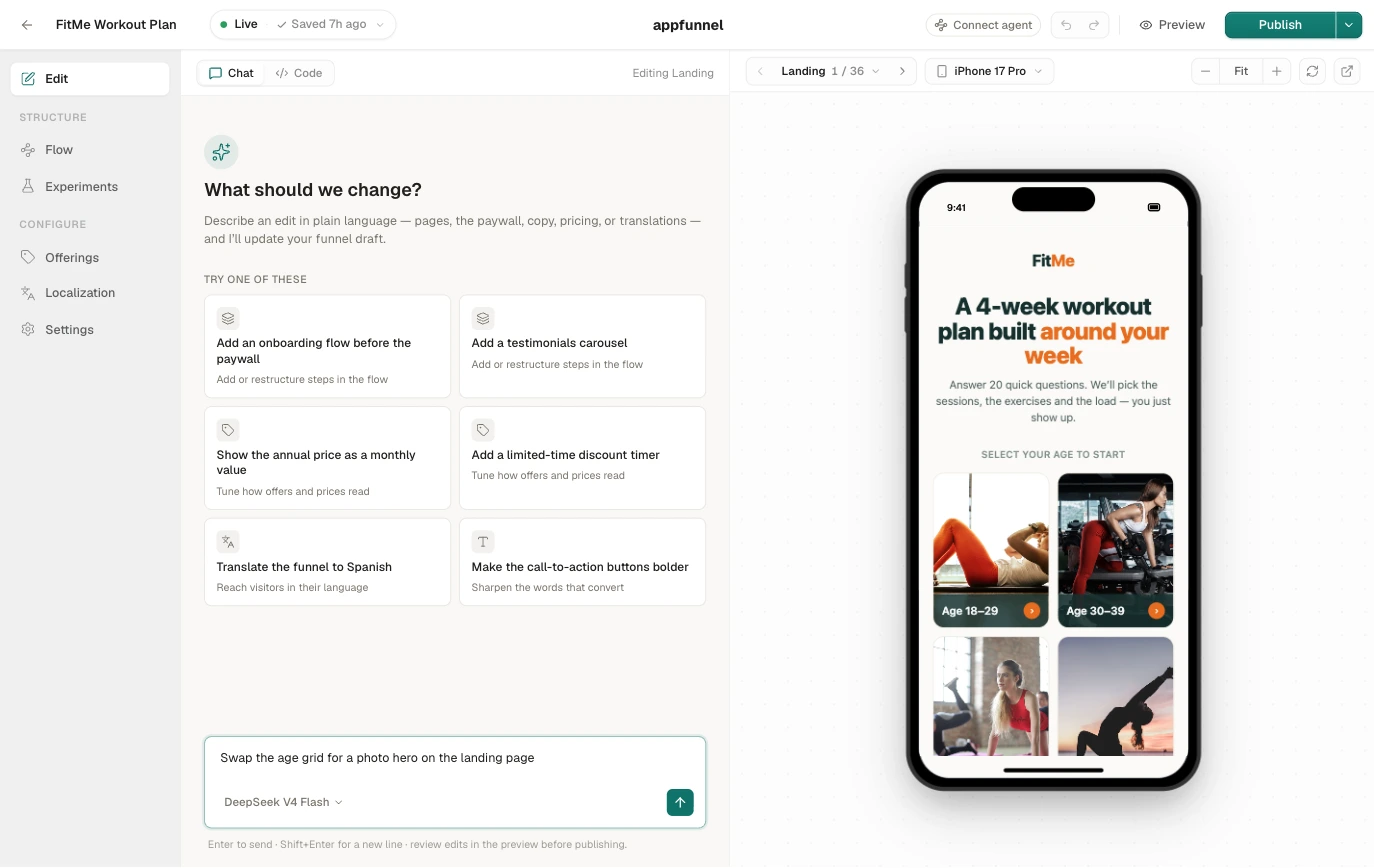
Build by describing, not configuring
You are not filling in a template. You describe the funnel you want, refine it against a live preview, and ship it. The builder writes the first draft so you edit from something real.
Describe, don’t configure. Say what the funnel should do in plain language and the builder drafts the pages, copy, and structure. You edit from something real, not a blank canvas.
A live phone preview. Every change renders instantly on a device frame, so you see the funnel the way a subscriber will before anything ships.
Publish the same day. Push to your own custom domain in a click. No build pipeline to run, no engineers to schedule.
Never locked in. Underneath, every funnel is a real React project you can export and own. The developer platform is the power ceiling, not a paywall.
From a prompt to a published funnel
Every step happens in one sitting, in one place, from an empty prompt to a funnel live on your own domain, without a handoff.
Describe the funnel
Tell the builder the goal, the audience, and the offer; it drafts the pages you asked for.
Preview on a phone
Watch it render live on a device frame and refine copy, layout, and flow in place.
Wire products and the paywall
Point each page at one of your products and drop in a checkout, priced in the buyer’s currency.
Publish to your domain
Ship to your own custom domain in a click; there is no deploy step to babysit.
Iterate with variants
Fork a single page into up to four variants and keep improving after launch. The funnel is never finished.
Quizzes, paywalls, and variants in one flow
A funnel is more than a page. The builder composes the whole flow (segment, sell, localize, and test), so the thing you publish is a working web-to-app machine, not a brochure.
Quiz flows that segment intent. Branch on what a visitor wants (“lose weight” vs “build muscle”) and land each answer in the funnel built for it.
Paywalls with real checkout. Wallets, cards, trials, and one-click upsells, powered by your own payments connection.
A/B variants inline. Fork any single page into up to four variants without leaving the builder, leave the rest of the flow alone, then let experiments decide the winner.
AI localization built in. Add a language in one click, ask the AI assistant to fill the translations, and review every string before you publish. Turn on location-based pricing and your payment provider resolves the local currency, so one funnel serves the markets you sell into.
Where teams use it
Launch an intent-matched funnel
Turn one product into a quiz that routes fitness, learning, or finance intent to its own flow.
Localize for a new market
Duplicate a proven funnel, translate the copy with the assistant, and turn on location-based pricing. Same weekend.
Replace a static landing page
Swap a flat page for a multi-step onboarding flow that segments before it asks for money.
Hand off to engineering later
Start plug-and-play, then drop into the code when a page needs something custom.
Questions, answered directly
Do I need engineers to build a funnel?
No. You describe the funnel in plain language, edit it on a live phone preview, and publish to your own domain. No code, no build pipeline, no engineering ticket. Engineers are the ceiling, not the requirement: when a page needs something the builder can’t express, the funnel is already code they can extend.
Is this a template gallery, or a real builder?
A real builder. There are no fixed templates you fill in. The AI drafts pages, quiz branches, and paywalls from your description, and you refine from there. Every page is a live React component underneath, not a locked layout.
What can I actually build, just landing pages?
Whole web-to-app funnels: quiz flows that segment intent, paywalls with real checkout, A/B variants, and per-locale copy. Each page points at one of your products, so pricing and offers stay consistent across the flow.
Am I locked into Appfunnel?
No. The funnel is yours to export and own, code and all. The term for “you can’t leave” doesn’t apply here. The builder is the fast path; the code underneath is the escape hatch, and both are yours.
Can my coding agents work on the same funnel?
Yes. The developer platform exposes the funnel over an editor session so coding agents, including Claude Code, can read and edit it alongside you, and a CLI pulls the project to your machine so you can edit it locally. Plug-and-play and code are the same funnel, not two products.
Related features
Payments & Billing
Five payment providers on your own account, wallets and upsells, orchestration when you scale.
A/B Experiments
Fork one page into up to four variants; know when you have a real winner and promote in one click.
LTV Analytics & Attribution
Ad-click to day-90 breakeven, with verified revenue fed back to the ad networks.
Subscription Management
Map products to entitlements and unlock the app from a web purchase.
Developer platform
The code underneath the builder: TypeScript, coding agents, and local development.
Describe your funnel. Publish it today.
Start plug-and-play, keep the code underneath: free for 14 days.